As we welcome the first warm days of May, your car’s battery is celebrating too. Just like us, batteries feel most comfortable between 20°C and 35°C (ideally up to 40°C). If the temperature drops below this, ions move sluggishly like honey; if it rises above, the chemistry ages significantly faster. In this month’s Tech Focus, discover how your car maintains this “Goldilocks zone” and the technology behind it.
1. High-Tech Under the Hood: How Batteries “Breathe”
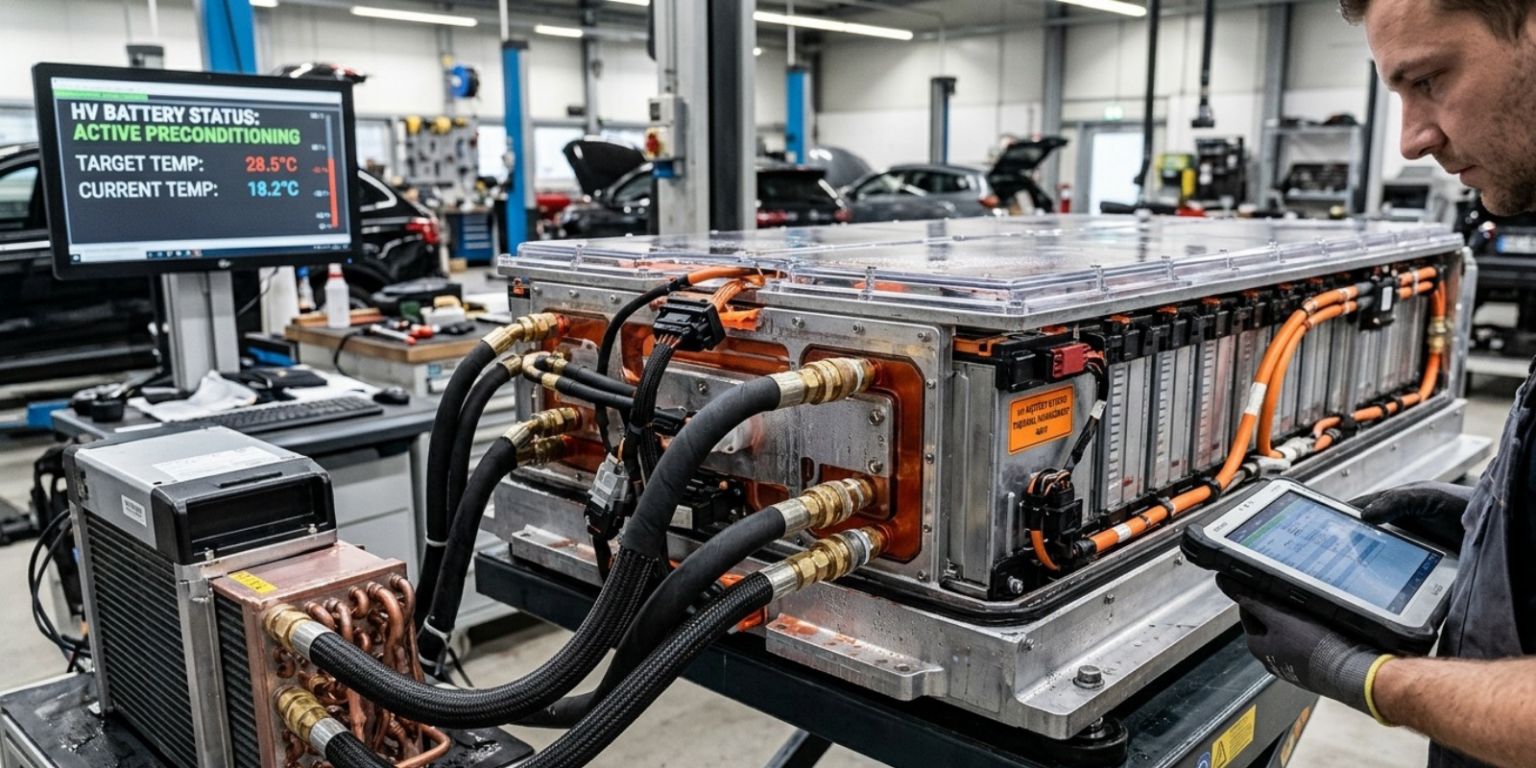
Manufacturers use various systems to regulate the temperature of the massive battery pack (often 400–700 kg). Depending on your model, one of these techniques is used:
Air Cooling (Passive/Active): Older or budget-friendly models (like the Nissan Leaf) often rely solely on airflow or a fan. While simple, this leads to the infamous “Rapidgate”: after several highway stints, the battery overheats, and charging speeds plummet because the heat cannot be dissipated fast enough.
Liquid Cooling (The Standard): Most modern EVs (VW ID series, Tesla, Hyundai/Kia) use a cooling circuit with a water-glycol mixture.
In Summer: If airflow at the front radiator isn’t enough, the car activates a chiller (a heat exchanger connected to the A/C refrigerant circuit) to actively cool the battery water below ambient temperature.
In Winter: Electric PTC heaters (similar to an immersion heater) warm the water to prevent the battery from freezing.
Heat Pump Integration & Motor Waste Heat: The gold standard in 2026. Tesla, for example, uses its famous Octovalve to intelligently shift heat between the motor, battery, and cabin. Even the motors themselves are used while stationary (stator heating) to generate heat for the battery without wasting energy. This saves valuable range, as the heater barely needs to pull energy directly from the battery.
You might have noticed: on a cool May morning, your car charges much slower at a High Power Charger (HPC) than in the afternoon. This is due to internal resistance. If the battery is too cold, lithium ions cannot migrate into the anode fast enough – the charging curve collapses. Manufacturers like Hyundai/Kia (E-GMP platform) use their 800V technology to bring the battery to the target temperature of approx. 25°C in record time, allowing the full 240 kW to flow immediately. The same happens with extreme heat: to avoid cell damage (degradation), the system throttles the power (Thermal Throttling).
You have more influence on the battery temperature than you think. Here is how to optimize your thermal management in :
Use Preconditioning (The Pro Move): If your car supports preconditioning via the sat-nav (standard on Tesla, Porsche, newer VW models), use it! The system brings the battery to the perfect temperature (approx. 30°C) during the drive to the charger so you can hit maximum speeds instantly.
The “Charging Sandwich”: Avoid parking the car in direct sunlight with a hot battery (right after a highway drive). Similarly, don’t plug a freezing battery into a fast charger. Tip: Charge the car immediately after your trip while the system is already at operating temperature, rather than letting it cool down first.
Gentle Starts in the Cold: If the night was frosty, avoid extreme acceleration for the first few miles. This protects the chemistry while the ions are still sluggish.
Report missing stations or incorrect prices.
Report missing vehicle models.
Upload details and photos of charging stations (e.g., info on shaded spots – crucial in summer!).